Does the Angle Change Along the Length of Longer Blades on the Wicked Edge?
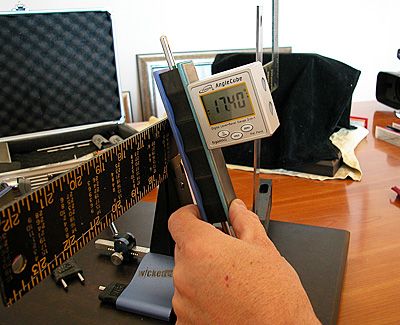
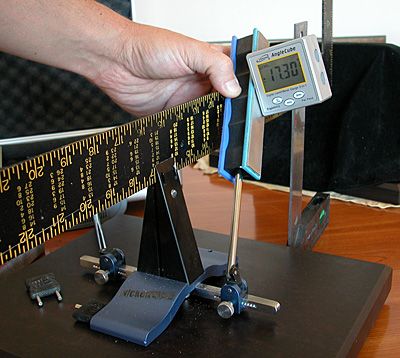
The image below shows the adjustment of the knife to find the “sweet spot”.

This issue comes up a lot and gives people fits but it’s very easy to solve. On a practical level, there are a couple of reasons why you might get a larger or smaller bevel along the curve of the blade
- As the stone rotates on the guide rod along the curve, it is constantly entering a new plane of contact. Depending on the curvature of the blade and the distance of the tip of the knife from the clamp, the change in bevel angle may cause the bevel to become wider or smaller. The effect is proportionate to the radius of the belly of the blade. The easiest way to find the ‘sweet spot’ for a given knife is to mount the knife with the blade approximately centered in the clamp and then color in the entire bevel with a Sharpie marker. After setting the angle, lightly swipe one of the fine stones down the length of the blade to see where the marker is removed. If the stone is removing the marker from the edge along the straight portion but then dipping down into the shoulder toward the tip, you know you need to reposition the knife with the tip closer to the clamp. If the opposite happens – that the stone removes the marker at the shoulder of the bevel along the straight portion and then moves to the edge along the curve, then you need to reposition the knife with the tip further from the clamp. Once you find the sweet spot, measure your knife’s position using the alignment guide and record the settings on the chart for future touch-ups.
- The second reason you might experience a wider bevel toward the tip of the knife is due to the way the knife is ground. As the belly of the blade curves toward the spine of the knife, the edge is often cut from thicker stock resulting in a wider bevel. An 1/8″ thick blade with a 22° per side angle will have much smaller bevels than a 1/4″ blade with the same 22° angles. On knives where the tip is inline with the spine and where there is not a distal taper, the effect is more pronounced. A wider bevel in this circumstance is a purely cosmetic concern since the angle is constant.
There is a fair argument to be made for intentionally selecting either a more acute or more obtuse angle at the tip depending on the use of the knife. Ken Schwartz and Wicked Edge agree that for a chef’s knife, it’s a benefit to have a more acute belly and tip for slicing and a slightly wider angle along the straight and at the heel for chopping. We prefer the reverse for boning and fillet knives since the tip is constantly in banging around on the bones. A knife designed for utility cutting or for thrusting would benefit from a more obtuse angle at the tip and a more acute angle along the straight portion of the blade.
By your logic a carpenter building a pitched roof would have to change the angle of each truss where it meets the outside wall as they got farther from the center of the building. The rod holding the stone is simply moving along the plane of the roof as you move it left to right and the angle where it meets the O1 is not changing - just like on a roof where the roof plane meets the outside wall. Your drawing is leading you astray because it mixes up two different views of the triangles in question. First view is the narrower triangle formed by looking down the O1 stock from the end - the tip or the handle of the knife. The second view creating the second triangle with the longer sides is looking at that second triangle also from it side. But that side view is found by looking over the top of the O1 stock from in front of the sharpener somewhere, not down the length of the O1 stock. If you turn the sharpener and look down the O1 from one end or the other while moving the stone along the piece of steel you'll see the stone is always moving in the same plane so making the same angle while contacting the piece of steel. Moving that to your drawing, if you stay in the same view of the triangles, the second larger triangle is actually completely hidden behind the first. You could also see this by laying a board or a piece of cardboard across the steel you are using to simulate a straight cutting edge and lifting it to the angle position you want to sharpen at on the upright. The board or cardboard always makes the same angle as it meets the steel along its full length.Just to clarify a bit. I'm not saying that the 2 triangles in the drawing aren't actual triangles relating to the cutting edge. Both do show something about the angle at the cutting edge. It is just that the sharpening angle is always measured at 90 degrees to the cutting edge, just like the angle of a truss. The second larger triangle is measuring the skew angle of some cut you might be making. The angle you are looking at in your second larger triangle is the effective cutting angle if you are pushing the knife forward and down in the direction the rod is pointing through whatever you are cutting. The effective cutting angle is measured directly in line with the cut direction. This effective cutting angle is lower than the actual sharpening angle in this case. That cutting angle is always lower to or equal to the sharpening angle depending on the direction of your cut. The more forward (or backward) motion you have relative to downward motion the lower your effective cutting angle. If you work with hand planes or chisels you are probably used to skew angles. You sharpen the blade at a set angle and if you cut with the plane oriented so that the cutting edge is 90 degrees to the cut then the cutting angle is a combination of that angle and the bed angle in the case of the plane - or just the sharpened angle in the case of the chisel. You might have trouble cutting pushing straight into the fibers of the wood. If that is the case then if you twist the plane or chisel slightly so that the cutting edge is not at 90 degrees to your cut, the cut will be much easier. That is because in relation to the wood you have effectively lowered the cutting angle. The wood fibers move over more of the bevel than they would have if you were cutting straight into the wood. You are also of course slicing instead of push cutting the fibers which helps too. This is the same of course for a knife on a tomato. Leonard Lee probably has the best explanation (and diagrams) of this I've ever read in the first chapter of his book on sharpening.